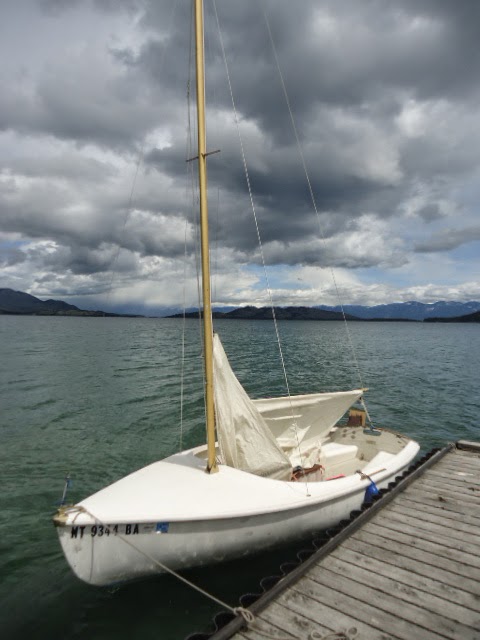
Friday, October 10, 2014

A Gift From Polson Bay

 The first time I ever sailed the boat I now call my own was on Polson Bay. And in two years I've never been back. But today marked my return. It's not that I haven't tried to sail in Polson. Far from it. But at the height of summer the dock is full of ski boats, fishing boats and PWC's. All of them want to get in and out as quickly as they can and it's nothing but motorized mayhem. Not the type of environment that cares about the needs of a fourteen foot boat powered by wind. The winds in the bay can be feast or famine and the chop builds up quickly. All of these factors make it a very challenging place to launch and sail a small boat.
 Quite recently I was diagnosed with Multiple Sclerosis. The flare up that led to my diagnosis seems to be fading but I was left with a real fear about my future as a solo sailor.Would I have the strength to sail alone? It's true that the amount of work it takes to get a sailboat on the water increases by the waterline foot but there is still plenty of work in a fourteen foot boat. And just yesterday attempting to the boat ready for sailing left me feeling utterly fatigued after only a few hours of doing things very slowly. What would happen on the ramp?
 Even as these thoughts were swirling around in my head I woke up and finished setting up the boat. It was today or May. The weather here in Western Montana is turning fall as if a switch has been thrown. It's going to go downhill for sailing very, very quickly. Looking at the forecast today was the only day with hope. How much hope? Tomorrow we have a wind advisory. Fresh breeze with gale force gusts. And then rain.
 The drive north wasn't bad. My destination was Big Arm. I had promised to stay in the bay and that was fine with me. I could go and give imaginary broadsides to my buddy Kirk's marina and call it a day.  I just needed a quick sail to finish the season. Deep down I was wondering if I could even manage that much. As I crested the hill and Flathead Lake spread out before me I wondered if maybe I could save half an hour and just go sailing in Polson.
 The signs were not good. The flags hung limp and the water glassy as I drove along the waterfront. I was resigned to the gas usage when just before the turn off to the Polson marina I saw an advertisement flag fluttering in the wind. I made a very quick left, found a spot and parked.
 The water was perfect. Just a touch of wind and no activity at the dock save for fisherman on the pier. I could still drive to Big Arm but why waste such a rare day? You don't. Not when you have your health and a boat.
 I took longer then usual to set up and launch. This was on purpose. With no timeline and not yet understanding my limits it seemed prudent. The dock at Polson is very much the same as at Georgetown. A huge gap between ramp and dock. I have no idea why they do this. At Big Arm it's a straight shot. At Dayton it is too. And the public dock there that ranks as one of the worst docks I've sailed off of. A gentleman on the pier was kind enough to take my bow line so I could get the truck parked once again. The sails were bent, the rudder attached, lines cast off and with the jib doing most of the work we sailed off the pier.
 There is something that amazes people when a sailboat leaves I've found. There is no roar of a motor and thrashing prop. Kids young and old stop what they are doing and marvel that the boat moves at all. And when your audience is used to powerboats it's a bit of smug satisfaction that accompanies the action of departing under sail alone. With the skipper whistling a sea chanty, a jaunty yachting cap on his head and tiller in hand Esmerelda and I headed for deeper water.
 The wind was light. Almost no wind but enough to make obvious way. I've often driven through Polson and wondered what the waterfront looks like from the water. Well I found out.
Looks just like the backside of a resort.
 I've been doing a lot of reading lately on sailboats. Mainly books of an instructional bent and I wanted to sail close hauled as much as I could. The appeal being that once my sails are set I have less to worry and fuss with. So I sailed from close hauled tack to close hauled tack. I worked on passing the rudder behind my back to keep facing forward. Keeping an eye on my telltales and sails and putting it all together. And I thought. A lot. About what sailing in the future could be like. Where I wanted to go. And time and time again about how time on the water beats a day at the office. And that helped.
 No matter what in the moment, right then I was sailing. My boat. By myself. And only the setting sun directing my actions. The sense of confidence and freedom given me was almost euphoric. I always feel good when I'm sailing but this time it was different. I had something to prove to myself and I proved it in good fashion. The worry and doubt went way replaced by focus and learned skill. I set mini goals of location and angle and carried out my own shouted orders. Had I the time and the wind I have no doubt I could have gone anywhere. And that alone was more then worth it.
 But eventually the sun, so much lower these days, beckoned me home. So I did something that while obvious was a new action to me. Well off the the breakwater I lowered my sails an motored in. And I make no excuses. Could I have sailed in and docked? I have no doubt I could, I've done it before. But the factors that dictate my actions lead to this decision. And I'm okay with that. I don't need to be the super uber sailor all the time. Nor should I be. I have my electric motor for a reason.
 I tied up at the far pier, pulled the sails off and made ready to get the boat out of the water. As I was doing this the rumble of an American V8, the sound of Godzilla gargling with marbles, entered my consciousness. The craft making this noise is what I can only call achingly gorgeous. She must have been twenty feet long, twin cockpits and cut through the water like a destroyer. I stood in awe in silent tribute of this wonderful craft. And I know without a doubt this was a motorboat with a soul.
Built in 1997 and powered by a 454 big block.

 So what did I learn on this trip? I learned that the present is where I am and to take things one day at a time. That dock designers in Montana have issues. That having a second line to tie a boat is a really handy thing. That sometimes even with the best of intentions you still get wet. And that your limitations are only found and explored through action. Whether of body and or mind. I'm so glad that the day before gale force winds Flathead gave me a gentle day on the water. As if to remind me that perfection can come when we least expect it and when it does show up to sit back and take it all in. Oh, and that in the right light or even the wrong light I have a very, very beautiful boat. And a wonderful companion on this new and continuing journey.


Sometimes you just get wet.

Monday, September 22, 2014

Looking Ahead


Sailing In Hand on Flathead Lake. September 2014
 The sailing season is winding down and it's time to take stock and make plans. Although I missed a huge part of this years season it was well worth it to have a boat in good repair and enjoying the company of friends. But as I look forward to the next season I have work before play. The list is short but definitive and I'll try and address each in turn.
  •  Hull Issues-This issue actually has a name and it's crazing. The topsides of my boat look like alligator skin. This is a common enough issue in a boat of this age. The best thing to do is to apply two coats of epoxy primer, sand with 120 grit sandpaper, then two coats of a two part polyurethane. The issue most likely will not be getting worse at this juncture but it sure is not getting any better. So that will have to be looked at.
  • Sail Issues-I need new sails. The jib is a bit worse off the main but both need at a minimum to be sent off to be cleaned and repaired. This will be started when the boat is done for the season. In the meantime a bit of sail tape will have to do.
  • Transom issues-I need to encapsulate my transom. Fiberglass cloth and resin. And paint.
 Those are the really big ticket items. The rest of my list is making my boat mine. Now for a long time I've harkened in my head the idea of doing a full restoration of the boat to it's 1962 glory with all the hardware as it was then. After this last sail I've abandoned that idea. I don't want to sail a half century old boat to say I do. I want to sail a boat that will take me where I want, when I want. With a minimum of fuss and less worry about how the past worked. I need the daysailer of today with a bit of nostalgia and class.  To that end I hope to make the following adjustments.
  • Updated Standing and Running Rigging-I need to get some new shrouds and halyards. The shrouds will be ordered new stock but I'm thinking of going modern on the halyards. Right now they are the classic wire/rope mix. In looking at what racers are doing I'm thinking that going with Spectra may be the way to go. Using a singe material for ease of maintenance and less to go wrong. I'm not sure how to rig it but it does intrigue me. New blocks are also on the list. I love the original Tufnols but getting new Tufnols or going with more modern blocks is a must.
  • Updated Main Sheet-As built the Lido main sheet goes from boom block, through the transom block, through the boom block, forward to another boom block and down to a combination block cam cleat on the centerboard. This works great in centering weight but leaves the sheet hanging in the middle of the boat. The Blanchard Jr. Knockabout's sheet comes over the tiller and is a better fit to the type of sailing I do. A wonderful example of this can be found in a demonstration aboard a Blanchard Jr. at the Center for Wooden Boats in Seattle.
  • Seat Cushions-I really needs these. Poor hips and knees are not happy on hard fiberglass benches. I want to do extended sails and my comfort is important.
  • Motor Option-Either fix my broken gas rig or find a battery for my electric. Goal is sail alone but having an option for no winds or mooring is a luxury I can live with.
That about covers plans. Here to more sailing in 2014!

Monday, August 04, 2014

PDR Madness

 The PDR I'm building is based on the third such boat ever build, named Bucket Ears. Overall plan is known as a a "Simple 18". I got the sides cut out in a day and now I'm working on getting the sides and bulkheads framed and chined. Getting the curve at the bottom is no doubt one of the hardest things about these small boats. But I've done it before.
 The PDR is different in many ways from the simple small boats I've built. The biggest and most obvious difference is the use of inside chine logs. All the boats I've built  and helped build have had outside chine logs. There is some debate in the boat building community about how much putting the logs on the outside really hinder or help performance. My thoughts are if you want performance in an an eight foot boat make it about four feet longer. I'm a bit put off by the mounting of the bulkheads but I have no doubt I'll figure it out.
 The chines are cut out of a 10' 2x6 and are 1x2 or thereabouts. I wet them before bending and with the help of a poor mans spanish windlass got the curve into them. On the second one I ended up using a ratchet strap to get the wood to move right. Nothing like a bit of redneck engineering. I have no idea how class legal this boat is. And right now I don't care. This boat was built to be thrown in the back of a pick up truck for instant and spontaneous adventure. No trailer. No fuss with registration. Just a fun knockabout boat for journeys on inland seas. And I think it will do just that. Even with a crack in the chine and some missing glue.

Saturday, August 02, 2014

Why Build a PDR?

  Why not? In a fit of madness and a small paycheck this Friday I find myself suddenly and quite without warning on the cusp of PDR ownership. What is a PDR? It is by my estimation the perfect small sailboat. See my essay here on small boats. The Woman has mentioned that she'd like to learn how to sail and I was in need of a new jigsaw and that is how I've come to having two eight foot hull panels in my bedroom and a host of other cut an uncut lumber littering two boat yards.
 The PDR has a vaunted history and pedigree that cannot be denied even by it's most ardent detractors. It's dirt cheap, dirt simple, sails well enough and better then almost any boat that length and has proven time and time again that just because it's a simple plywood box does not mean it's a boat.
 A huge draw is the whimsey with which sailors are allowed. At this formative point I think I shall paint mine to resemble a frigate of the Napoleonic wars with (painted) gun ports and all. Some buff yellow and tan interior I think. A four sided sail of some variety. Side mounted leeboard.
 Time line calls for completion around mid August. Then it's off the pond for sailing. And why not, what building a boat is for.

Wednesday, June 25, 2014

Accident or Incident

An expensive fiberglass flowerpot.
The first time I looked at my boat in around two weeks she had plant life growing from her centerboard slot. How this came to be is quite a story. During her last time out at Big Arm Esmerelda struck the bottom hard while still at the dock, forcing the centerboard through the slot and cracking the board in the process. The vessel was for all intents and purposes unusable.
 However with the help of The Typesetter, we are now bringing my Lido back to sailing shape once more. The first task was to get a piece of wood suitable for a new centerboard. Mahogany was chosen as that was the wood used in the original construction. The basic idea was to recreate the board we had minus the dents, dings and general abuse the old board had received.
 First step was using a plane to get the general shape of the foils right. This requires a bit of omph and when using a work table that is not nailed down can get exciting for the onlookers. After marking out the general dimensions and finding them class legal shaping began. It took about 30 minutes of planning a side to get the shapes rough. Now comes the sanding and the varnishing. And the varnishing. And the more varnishing.
 Not to shabby for an hours worth of work. Still have the final shaping and riveting to go. Many would buy a new centerboard but why buy it when you can build it? Also on the list of things to accomplish is adding a mast carry set up like that seen on Lido #53 which serendipitously ran into at my work and changing the trailer lighting to a light bar. The motor should be ready for testing in the next two weeks as well. If all goes as planned, Esmerelda should be back in action, and out of The Typesetters back yard in two weeks. Here is hoping!

Friday, May 09, 2014

If You Have to Ask What Boat Stands for...


Cromwell Island to starboard 2013
 The Lido and trailer need a bit of touch up work after only two sails this season. But what's another thirty or so? Which in my case it what boat stands for as I've not quite spent a grand on my fiberglass hole in the water I'm throwing money into. Today the prime expense is a new tiller. The Typesetter built a very pretty laminated tiller to replace the one that came with the boat. It's worked well but we've had consistent cracking problems at the rudder end and after this last sail it's to the point I can't really trust it anymore. Nothing like hearing the crack of wood when you come about. So I bit the bullet and ordered a new H and L Marine tiller off of Ebay. I did some research on H and L and they come highly recommended, having made tillers for production boats for years. They may have gone out of business recently so I figured why not, the price was the same as from the Schock website. Should be arriving in a few days, I'm quite excited.
  My trailer is very slowly giving me reason to want to a priest to bless it. There is a ground fault that enjoys blowing my trucks taillight fuse randomly. The Harbor Freight trailer jack refuses to stay put. And the bolt that holds the knob style hitch went missing during the last transit. Today I completely dissembled it to make it work better. Bought a new bolt at Ace Hardware and spent an hour on my back trying out various forms of profanity to see if one word or another made the job easier or if a combined string had any effect. I should just put a proper hitch on it but it works for now. Added a lock nut so the bolt shouldn't disappear so easily.
 And with that I'm done sailing for at least a week or more until the new tiller shows up. At some point soon I need to get a new centerboard and a new rudder, as both are showing their half century of service. The rudder has a bit of a twist along its lower sections and both are pitted and worn. The centerboard has seen numerous rocks, trees, monsters in it's life.If I want to keep sailing I need to replace them.
  I think part of owning an object is making sure that's it's done right to the best of your ability as soon as  you can. If something is wrong or off or doesn't work right, fix it as soon as you can. Don't wait, don't hesitate. Objects we like and cherish deserve this treatment. And besides a boat you can't take out today because of something you should have done yesterday does you no good tomorrow. Or something like that. 
 While looking over the forums and then looking over the boat I see that the mainsheet block was moved aft about six inches from it's original location, a modification that is recommended for racing boats. There are four plugs where the old screw holes were. I'm guessing it was moved during the time it was a saltwater boat. Maybe when it was listed on the class register 1964-65. Makes me wonder about Esmerelda's first owner. Was she purchased to race? How did she do? And what journey did she take that caused her to end up sailing fresh water in the Big Sky Country?
 I've been looking over the internet for video's of other Lidos and I must say I'm not a fan of the 6000 series. They lack a certain texture that appeals to me in my boat. Gone is the wood and "brass" accents that highlight various parts. Where do you store stuff for a day sail with the fo'c'sle all boxed in? And the rudder is now pure pintles and gudgeons, the the elegant solution provided by the classic boats. I can't fault it for what it is, a modern sailing dinghy but it's nice to know it came from classic roots, although fiberglass it's easy to see my boat in wood. And I'm more then okay with that.

Wednesday, May 07, 2014

Soul of a Thoroughbred


Waiting for the starting bell
  The Woman went looking for a a truck, which happened to be about thirty miles from my favorite sailing spot so SV Esmerelda, my truck and herself went to go look at it. The weather was forecast to be a bit heavier but "good sailing" according to most charts. I figured if it was too much we could bail and go explore Polson or something. It was a fine plan.
  Surprisingly the weather seemed fine upon our arrival at Big Arm State Park. After looking at the water and feeling the wind I judged were I at the local scum pond I'd take a Teal out there we got the boat rigged and ready. Now it should be noted that we have no true sailboat docks anywhere on the lake. To my knowledge not one public dock was set up with sailboats in mind. The wind was blowing parallel to the dock, stern on from the launch. I managed to get the boards down and the mainsail up in such a fashion as not to alarm the crew. With everything ready, I let go the lines and we started toward the shore, tiller hard over.
  You know how in a disaster things happen really quickly? Thankfully I have seen the events before. First I discovered that at low fill I can find the bottom with the centerboard pretty easily. However it does not get caught it just makes a very expensive sounding noise. If you've been bored enough to read this blog in it's entirety you know I had a bit of an issue with snap jibes and boom skying on the SV Blue Flower. Well turns out a Lido 14 does it pretty well too. Due to the wind I left the dock on a run, and turned up. There was an immediate snap jibe followed by the boom skying and the top of the sail wrapping itself around the mast. Unlike my Teal I can shift weight a bit better and got the boat stabilized and headed into the wind while I set about fixing the issue.
  A tug on the sail got the main unwrapped and set and I set about finding a close hauled course while I got the jib up. I can't say enough good about the crew who followed my hurried orders and help to keep the boat balanced. After sorting out what was moments ago nicely placed and ordered lines we were on a beam reach and headed out into the lake. With a chance to look at the sails I noticed there was a deep draft and figured I'd flatten it a bit to get the power down. It didn't work.
The Deep
  I asked the crew to get the GPS and keep track of our speed and course. Now the hull speed of a Lido 14 is about five knots. We maxed out at 5.5kts on our run out. It seems the boat only wanted to race. "Settle down Esmie" "No! Let's go fast this way!" "I don't want to go fast right now I'd like to figure out how this works" "No! Go fast!" "I appreciate the sentiment but I'm not sure that's the best idea right now. I'm trying to figure out sail trim and-" "Fine. You're not listening, hold on. We're going fast. GUST!!!!!" (With apologies to Tom Pamerin and Jagular. My boat talks too.)
  I'm not ashamed to admit I was a bit nervous. Once more the boat never felt that she was going to go over or anything but being in rather large and very cold water I wasn't as brash as I would be in a small pond with the shore a swim away. So there was much feathering and air spilling and somewhat frantic orders at times. In the end we were out for about thirty minutes and other then a rather interesting start, the sail was a good one.
  I'm learning to sail all over again with this boat. It's obvious she's got a mind about and that mind involves thoughts of speed. I'm not sure what kind of sailing was done with this boat in the past half century but I'm now certain it involves racing and lots of it. On the water the years fall away and this boat just wants to go fast. There was a kayaker on the bay with us and I'm now certain the idea was to go faster then the kayaker could have gone.  However her current skipper isn't quite ready for fast. And I'm not quite sure what to do about that. I have purchased a boat with the heart of a racehorse. Never mind the slightly misshapen sails, the missing trim pieces, the bare fiberglass on the floor and the questionable transom. I'm certain given some courage and a good breeze I could go anywhere I wanted at a speed I've not experienced under sail.
  It's a bit intimidating but I'm excited for the future. I need to fix the trailer and get another tiller but so help me I'll sail for a 3/4 of an hour but June. And maybe go a bit faster. Or a lot.

Thursday, May 01, 2014

All the Fun Before Noon

  I now know what to do if I loose my forestay with the jib up. I could write it up in an epic post but it turns out I did a short video shortly after the event and will let myself do the talking.
It was a good day, if an eventful one. I learned a few things and I'd like to pass them on.
  • Rig Tuning. Rig Tuning. Rig Tuning. The recreational tuning for a Lido is to have little or no movement of the mast. That can't be overstated if you're cruising in a Lido.
  • The importance of good line If the turnbuckle had broken or the crimp come undone I was in a position to jury rig a new forestay with the paracord I keep in the anchor bucket. Having that 20' of line is important in so many ways.
  • Doing one thing at at time. I was suprised in how easily and naturally my triage of the boat was. I took it one step at a time, not rushing and working through the problem. I think my experience and preparation through running steam boilers and years of martial arts training have given me a set of problem solving skills that befit a solo sailor.
  • In looking back at the event I never felt that the situation was spiraling out of control or that I was in immediate physical danger. Yes the water was cold but my forethought as far as the weather and conditions meant the boat was stable and upright throughout the the monkeying on the foredeck. As a matter of fact the only water that entered the boat was the spray from intentionally beating through waves and the ice that fell out of the cooler. 
  I couldn't ask for a better first sail when something goes wrong. I remember yelling at the lake as I held my forestay in one hand behind my head while trying to get the clevis pin in with the other hand that it didn't get to win. The commentary alone must have been interesting. "Oh no you don't! Give me that. Fine. There. Okay what's next. Damn sail.  GET UP THERE!!". 
  The Typesetter and myself plan to go out again in two days time. I'm glad I had this chance to figure it all out. Because it'll only get better.